- Published on
The Flame of Aspiration: A Meditation on the Agni Suktam (Rig Veda 1.1)
- Authors

- Name
- Maa's Beloved
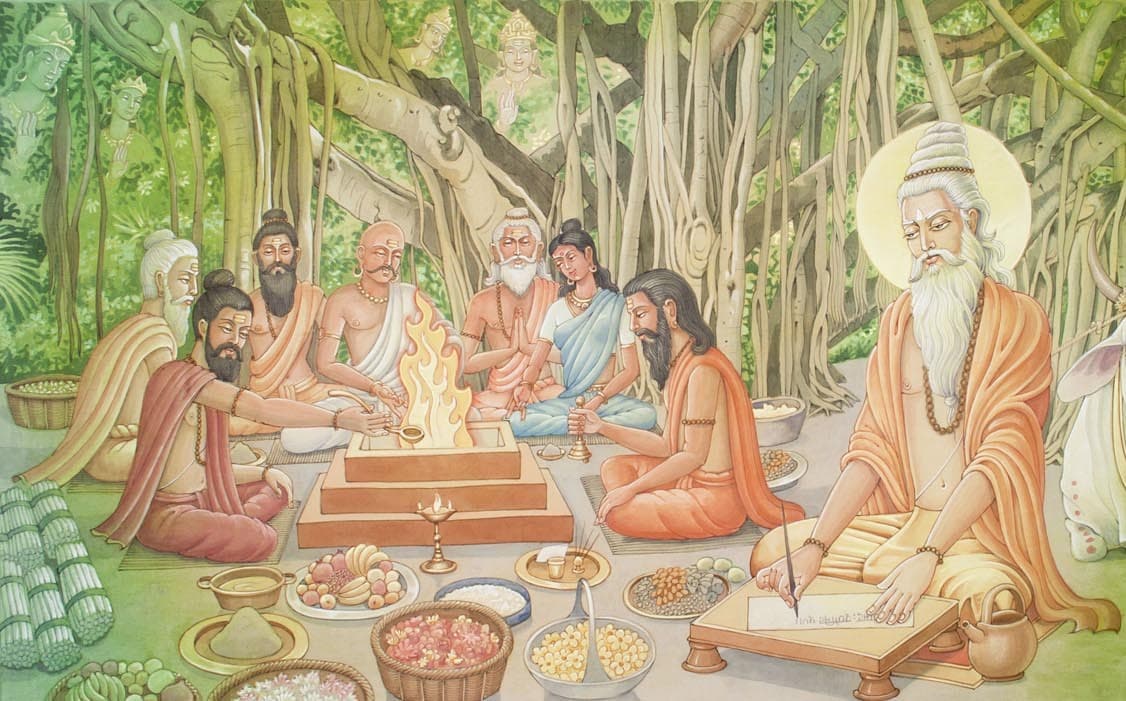
The Rig Veda is the most foundational and ancient of the Vedas and of Hindu scriptures at large. I recently read the Agni Suktam, the first hymn (1.1) of the Rig Veda, and it was so profound, I found myself in a state of utter shock for about two weeks just trying to process it. It is truly such a rich hymn and contains within it the seed of so much of later Indian philosophy. In this essay, I hope to provide a short analysis that teases out some of the insights I drew from reading this Suktam, beginning with a personal translation of the hymn. My translation and interpretation are heavily influenced by Sri Aurobindo's work in his book Secret of the Veda, where he provides what I believe is a robust philological argument for an adhyātmic (spiritual / psychological) interpretation of the Rig Veda. All Hindus believe that the Upanishads are the culminating essential philosophy of the Vedas, but whereas in existing reductive translations and interpretations, this transition from the Vedas to the Upanishads seems jarring and almost insensible, in the adhyātmic interpretation, we suddenly find the Upanishads to be a clear and natural expression of the truth of the Vedas. I hope to write some further thoughts on this in a future post, but for now, I highly recommend reading Secret of the Veda to those interested in further studying the Vedas.
In the translation below, I've made it so that you can hover over any word to see the corresponding word in the translation, so please take advantage of this if it's helpful.
Agni Suktam (Rig Veda 1.1)
agnim ǀ īḷe ǀ puraḥ-hitam ǀ yajñasya ǀ devam ǀ ṛtvijam ǀ hotāram ǀ ratna-dhātamam ǁ (1.1.1)
I adore that Agni, placed in the front of the yajña, the deva, the ṛtvik who performs the sacrifice in accordance with Truth, the hotṛ who voices the call to the gods, the one who most bears spiritual riches.
agniḥ ǀ pūrvebhiḥ ǀ ṛṣi‑bhiḥ ǀ īḍyaḥ ǀ nūtanaiḥ ǀ uta ǀ saḥ ǀ devān ǀ ā ǀ iha ǀ vakṣati ǁ (1.1.2)
Agni is adored by the ancient seers as well as the new. He brings the gods here.
agninā ǀ rayim ǀ aśnavat ǀ poṣam ǀ eva ǀ dive‑dive ǀ yaśasam ǀ vīravat-tamam ǁ (1.1.3)
By Agni, one may enjoy an inner treasure which increases day by day, which is glorious and most endowed with heroic qualities.
agne ǀ yam ǀ yajñam ǀ adhvaram ǀ viśvataḥ ǀ pari‑bhūḥ ǀ asi ǀ saḥ ǀ it ǀ deveṣu ǀ gacchati ǁ (1.1.4)
O Agni, that rightly‑ordered and uninterrupted yajña which is surrounded by you on all sides, that alone reaches the gods.
agniḥ ǀ hotā ǀ kavi‑kratuḥ ǀ satyaḥ ǀ citraśravaḥ-tamaḥ ǀ devaḥ ǀ devebhiḥ ǀ ā ǀ gamat ǁ (1.1.5)
Agni, the hotṛ, the Seer‑will, the deva, is true (undefiled by falsehoods) and of most radiant and manifold renown. May he come with the gods.
yat ǀ aṅga ǀ dāśuṣe ǀ tvam ǀ agne ǀ bhadram ǀ kariṣyasi ǀ tava ǀ it ǀ tat ǀ satyam ǀ aṅgiraḥ ǁ (1.1.6)
Truly, that good which you shall create for the giver, O Dear Agni, that indeed is the truth of you, O Añgiras.
upa ǀ tvā ǀ agne ǀ dive‑dive ǀ doṣā-vastaḥ ǀ dhiyā ǀ vayam ǀ namaḥ ǀ bharantaḥ ǀ ā ǀ imasi ǁ (1.1.7)
We approach you, O Agni, day by day, in the night and in the light, carrying our reverence by our attentive thought.
rājantam ǀ adhvarāṇām ǀ gopām ǀ ṛtasya ǀ dīdivim ǀ vardhamānam ǀ sve ǀ dame ǁ (1.1.8)
Agni reigns over rightly‑ordered yajñas as the luminous guardian of Truth. He is increasing in his own home.
saḥ ǀ naḥ ǀ pitā-iva ǀ sūnave ǀ agne ǀ su‑upāyanaḥ ǀ bhava ǀ sacasva ǀ naḥ ǀ svastaye ǁ (1.1.9)
He is to us as a father is to his son. O Agni, be of easy access, dwell with us for our well‑being.
Who is this Agni to whom our praises are directed? In the Vedas, the devas or gods are each particular powers of consciousness (this is the sense in which, as we find later in the Rig Veda, they are children of Aditi, who Sri Aurobindo argues represents the vast illimitable ocean of consciousness, free of dualities and full of dazzling power and potentiality). These devas aid the aspirant in breaking open the light hidden within them, which is otherwise covered by the forces of darkness or avidyā. Though we will find many keys in the Veda that point to the identity of Agni, we already find one of the clearest pointers to his identity in verse 1.1.5 of this hymn, where Agni is described as kavi‑kratuḥ (1.1.5). Here, Sri Aurobindo explains, kavi, which in later Sanskrit comes to mean poet, in the Vedas refers to a seer, one who has revelatory knowledge or wisdom. kratuḥ, on the other hand, refers to will or conscious movement. Taken together, we then see that Agni is kavi‑kratuḥ, one whose will is that of a seer.
Agni is that Divine will which proceeds from Truth itself. This is why he is ṛtvijam, one who performs the yajña in accordance with Truth (1.1.1). This yajña is not merely the ritualistic fire sacrifice1, but, as revealed in the Gita (4.24-4.33), is the yogic process as a whole, in which the separative ego is given up and offered for the sake of a deeper communion and unity with the divine. In this yajña, the hymn declares, Agni is placed in front (1.1.1), or in other words, he leads the yajña in the aspirant. What does Agni lead the aspirant towards? He leads us to bhadram, auspicious happiness or that which is good (1.1.6). This is his essential truth, satyam (1.1.6), his telos, the underlying direction in which his divine will within us directs us. In fact, the very etymological meaning of Agni's name points us towards this truth of his. Kṣīrasvāmin, an 8th century Sanskrit grammarian, explains that the name Agni means "one who moves upwards" (aṅgati ūrdhvaṃ yāty agniḥ) [4]. Agni is that divine flame which always reaches upwards within us towards our highest, most auspicious bliss. In the Republic, Plato says,
"Every soul pursues the Good and does its utmost for its sake. It divines that the good is something but is perplexed and cannot adequately grasp what it is or acquire the sort of stable beliefs about it that it has about other things." (Republic, 505e)
Agni is that faculty within us which constantly strives for the manifestation of the Good. This is why Agni "brings the Gods here" (1.1.2). Even when all the other devas or divine faculties of knowledge, vastness, energetic force, purity, compassion, mystical intuition, etc. are dormant within us, and we are shrouded in darkness, Agni is the inextinguishable flame, always awake and calling, whether quietly or with great intensity, for the gods to manifest and awaken in us. It is this flame in the cave of the heart which the Kaṭha Upaniṣad recalls when it declares, "aṅguṣṭhamātraḥ puruṣo jyotirivādhūmakaḥ",
That Puruṣa (Self), of the size of a thumb, is like a flame without smoke (Kaṭha Upaniṣad) 2
But what of this perplexity that Plato speaks of? While it is said that Agni leads the yajña, in our everyday action, the loud clamor of our egoistic desires, aversions, anger, and pride drown out and cover the sacred word or mantras which Agni speaks as the hotṛ, the summoning priest. For this reason, we find his will hardly discernable in us, and our action is far from kavi‑kratuḥ, from that action of a seer of Truth.
Here, we find the core motivation for the Hindu practice of surrender. Verse 1.1.4 says, "O Agni, that yajña which is surrounded by you on all sides, that alone reaches the Gods." It is for the cultivation of this yajña that the Gita calls us towards niṣkāma-karma, action that is completely free of egoistic desire. In Gita 3.9, Sri Krishna says,
Works other than those performed for the sake of yajña bind one to this world. Thus, O Arjuna, with the pure aim of yajña, perform your work properly, completely free of attachment.
If we can silence those clinging attachments and aversions of the ego, then Agni can spring forth and take his rightful place as the reigning Lord of our yajña (rājantam adhvarāṇām) (1.1.8). Then as the divine will within us, Agni will lead us to that inner treasure which increases day by day (1.1.3), he shall bear in us those beautiful spiritual jewels and riches (ratna) (1.1.1) of ānanda, compassion, fearlessness, and so on. In other words, he will guide us unto our own Good. And so, in order to purify our hearts and mind of the clamor of egoism, we engage in sādhanā, meditation, prayer, etc. As the Agni Suktam says, "we approach you, O Agni, day by day, in the night and in the light, carrying our reverence by our attentive thought" (1.1.7).
And in this aspiration, we need not fear. Sri Krishna says, "abandon all duties and take refuge in Me alone. I will liberate you from all sins, do not grieve" (Gita 18.66). Agni is described as "gopām ṛtasya dīdivim," the luminous guardian of Truth (1.1.8), but he is not so in a distant separated sense, guarding some alien Truth in an alien land. No, he reigns over and shelters and cares for our own Truth. And so, "he is to us as a father is to his son," and we may call out to him, "Be of easy access, O Agni. Dwell with us for our well-being" (1.1.9). And he is certain to hear our call and aspiration, and to lead us unto our highest fulfillment. This is the seed of the bhakti yoga which is later further expounded in the Gita and Puranas.
This entire manifest universe is the progressive growth and expansion of Agni. Agni is described later in the Rig Veda as the child of Heaven and Earth (RV 3.1.3). His home is in the divine Truth and the Vast (ṛtaṁ bṛhat) (RV 1.75.5), and yet he is established within each individual birth in the world (RV 3.1.20), and "increases" with each individual's transformation towards the divine (or equivalently, with the manifestation of the divine into each individual). It is in this sense that "[Agni] is increasing in his own home" (1.1.8). It is only by Agni, the spark who joins the worlds of the heavens and of earth, of the divine and the manifest, that yoga, which is none other than the process of unifying the individual with the divine, is possible. If we contemplate on this further, I believe we also find in Agni the secret possibility of the incarnation, the avatāra, the Son of God in whom the inner flame proceeds outward without hindrance. But a discussion on this will have to wait for commentaries on future hymns in which this possibility is more evident.
May that great Agni lead us unto our greatest good. Hari Om Tat Sat!
References
- Rig Veda (Referenced translations by Sri Aurobindo, T. V. Kapali Sastry, R. L. Kashyap, and Ralph T.H. Griffith)
- Secret of the Veda by Sri Aurobindo
- Siddhānjana, a commentary on the Rig Veda by T. V. Kapali Sastry
- Kalātattvakośa Vol. 3: Primal Elements - Mahabhuta by Kapila Vatsyayan
- Kaṭha Upaniṣad
Footnotes
The term yajña is one of those Sanskrit words with very rich context that is missed in a direct translation. The literal translation of yajña is 'sacrifice,' and the term is most commonly used in the Hindu tradition to refer to a traditional ritualistic process by which prayers and offerings are given up to God through a sacrificial fire. But as we see next, this fire sacrifice is a particular ritualistic expression of the broader movement of yajña as a whole. In fact, in this broader sense, even creation as a whole is seen to be the result of a great yajña. ↩
In fact, the Śatapatha Brāhmana states this relation of Agni to Puruṣa even more directly. In section X.6.1, the Śatapatha Brāhmana relays a story in which several brahmins went to the king Aśvapati Kaikeya in order to learn of the real nature of Vaiśvānara (an epithet of Agni). The king explained, "This Agni Vaiśvānara is no other than Puruṣa; and verily, whosoever thus knows that Agni Vaiśvānara as Puruṣa-like, as established within Puruṣa, repels death, and attains all life." [4] ↩